The Night Her Cough Sounded Different
I have stood in a dark nursery at 2 a.m. more times than I can count, phone in one hand, sleeping toddler in the other, trying to decide: do we go to the ER, or do we wait it out? This is the story of the small device that finally gave me something to hold onto.
The 2 a.m. decision every parent knows: go, or wait?
It was the third night of the cough, and around 2 a.m. it changed. It had this tight, barky edge that it did not have the day before. I sat up in bed and just listened, one eye open, counting the seconds between each breath. And I thought the thought that every parent knows by heart: am I overreacting, or is this the one I should not have ignored?
I did what I always do. I opened my phone and recorded it, the way you record a cough to show the doctor in the morning, because you know that by the time you are in the waiting room she will sound perfectly fine. But a phone microphone in a quiet room does not capture what is happening inside a small chest. It captures a room. And a room does not tell you anything.
So we went in. The waiting room was full. Three hours later a very kind, very tired doctor listened to her chest for about twenty seconds, told me it was viral, and sent us home. Two weeks after that, a bill arrived for fourteen hundred dollars. Fourteen hundred dollars to be told to do exactly what I would have done anyway, which was wait.
I was not angry at the doctor. I was angry that I had no way to know. The next time she got sick I tried telehealth instead. The doctor on the screen was warm and thorough, right up until the moment she said the sentence I have not been able to forget: "I would really need to listen to her chest." And then, because she could not, the call ended. I was right back in the dark, guessing.
What I did not know that night is that the gap I kept falling into, the space between "something sounds different" and "a doctor can actually hear it," is exactly the gap this whole story is about closing. I am not in that gap anymore, and by the end of this I will show you why.
What if you could hear what the doctor hears?
A few months later a friend, another mom who runs her household's health decisions like a full-time job, showed me something on her kitchen counter. It looked like a smooth little puck, about the size of a hockey puck but lighter. She put it against her son's back, opened an app, and recorded thirty seconds. Then she did the thing that made me stop and stare: she sent that recording to their pediatrician.
Not a shaky phone video of him coughing. The actual sound from inside his chest, the kind of sound a stethoscope picks up, captured clearly enough that a clinician could listen to it. She was not trying to diagnose anything herself. She was doing something much smarter. She was giving her doctor real information instead of a panicked description at 8 a.m.
That reframe is what got me. I already record. I already track. I already show up to appointments with notes and timelines because I refuse to be the parent who forgets the important detail. This was not asking me to become a different person. It was handing the parent I already am a real instrument.
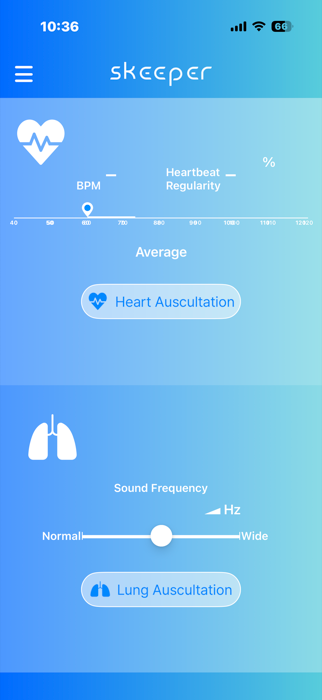
The Skeeper app: record about thirty seconds, then share it with your doctor.
The Skeeper SM-300
It is a consumer FDA-cleared 3-in-1 smart stethoscope made for parents, not just clinicians. Heart, lung, and fetal modes in one device the size of your palm. You hold it to the chest, record about thirty seconds of clear, high-fidelity sound, and share it with your pediatrician. It captures the same kind of sound a stethoscope picks up, so you can hand your doctor real audio instead of a description.
Three modes, one device
Heart, lung, and fetal modes in one FDA-cleared device.
About 30 seconds
Capture a clear recording in the moment, then keep it or send it.
A passive microphone
It only listens. It is a passive acoustic microphone, not an ultrasound. It sends nothing into the body.
Share with your doctor
Give your pediatrician better information than a phone video ever could.
The Skeeper SM-300 with the Skeeper Pro app.
See how it works
Take a closer look at the device, the modes, and what it captures.
See the Skeeper SM-300Why it is not just another monitor that beeps all night
This was my biggest worry, honestly. I already owned a sock monitor when my first was a baby. And I remember what it actually did to me. It went off in the middle of the night, over and over, for readings that turned out to be nothing, a wiggle, a slipped sensor. Instead of peace of mind it gave me a heart pounding out of my chest at 3 a.m. So when my friend showed me the Skeeper, my first thought was: is this just one more thing that is going to keep me awake and terrified?
It is the opposite, and this is the whole point. The monitors are always-on alarms. They watch continuously and they scream when a number crosses a line, and a lot of the time the line is wrong. The Skeeper is episodic. You reach for it in the moment you are already worried, you capture the sound, and then you are done. It does not sit on the crib all night waiting to spike your anxiety. There is no alarm to cry wolf.
Here is what I did not expect to matter as much as it does. The other devices hand you data and then leave you alone to figure out what it means, which is its own kind of anxiety. Skeeper does the opposite: it gives you a real recording you can hand to your own pediatrician, the person who actually knows your child. You are not left interpreting a waveform by yourself in the dark. That is the difference between a gadget and genuine peace of mind.
A note on the fetal mode
The Skeeper includes a fetal mode, and I want to be precise about it because I know how many families have been warned off the sketchy consumer dopplers online, and rightly so. This is different in the way that matters most: it is a passive microphone that only listens. It is not an ultrasound. It does not send any energy into your body. It simply captures sound, the same as it does for a chest, and lets you share that recording with your provider. It is not a substitute for your prenatal care, and it is not there to reassure you that anything is or is not fine. It is a way to hear, and to share what you hear with the professional who guides your pregnancy.
I am not the only one
Before I bought anything I did what I always do and read everything I could find. The account that convinced me was not a marketing line. It was from a former flight medic, someone who has spent a career listening to bodies under the worst possible conditions.
"I spent years listening to patients in the back of a helicopter with rotors screaming over my head. Audio quality is not a nice-to-have to me, it is the whole job. I field-tested this against the consumer devices I could get my hands on and it was not close, the clarity was well beyond anything else I tried. For a parent who just wants to capture what is happening and get it in front of a doctor, it does exactly that."
The scenarios below are representative examples of how families use the device, not testimonials from specific verified customers.
"My daughter's asthma means every fall is a vigilance marathon. Now when I hear something I capture it, and I walk into the pediatrician with a real recording instead of me doing a bad impression of a cough. It changed those appointments completely."
"We came home from the NICU with our son and, overnight, went from being watched around the clock to nothing. Being able to capture a sound and send it to someone who knows gave us back a little bit of solid ground to stand on."
"The thing I love is that it does not beep at me. I had a monitor before and it made me a wreck. This one just sits in the drawer until I actually need it, and then it does exactly one job really well."
"Being able to text my pediatrician a clean recording instead of describing a cough over the phone is the feature I did not know I needed. I feel taken seriously now, and I do not feel like I am guessing anymore."
What it costs, and how to make it easier
I will be honest that this is a real investment, not an impulse buy. A recording does not replace a visit, and it will not decide for you. But I kept coming back to that fourteen hundred dollar night of not-knowing, and the idea of walking into the next one with real audio to share instead of a guess, and the math started to look very different. Here is what helped me decide.
HSA / FSA
The Skeeper SM-300 may be eligible for HSA or FSA funds. Check with your plan administrator, since some plans may ask for a letter of medical necessity.
Pay over time at checkout
Shop Pay Installments lets you split it into smaller payments at checkout instead of paying all at once, subject to eligibility.
- FDA-cleared consumer smart stethoscope
- Records clear audio in about 30 seconds to share with your doctor
- A passive microphone that only listens, never an ultrasound
- Share recordings as a secure audio link that plays in any browser, no software on your doctor's end
Stop guessing in the dark
Walk into the next scary night with the real sound to share, not a guess. See the device, the modes, and the current price.
See the Skeeper SM-300I still think about that night, the barky cough and the fourteen hundred dollar shrug and the telehealth doctor who could not do the one thing she needed to do. I cannot get those nights back. But I do not have those nights anymore either. Now when something sounds different, I reach into the drawer, I capture it, and I send it to someone who knows. That is all I ever wanted: not to be told everything is fine, just to stop being alone with the not-knowing.